






Home › Blog › Yoga Poses & Asanas
What Is Acro Yoga? Base, Flyer and How to Start Safely
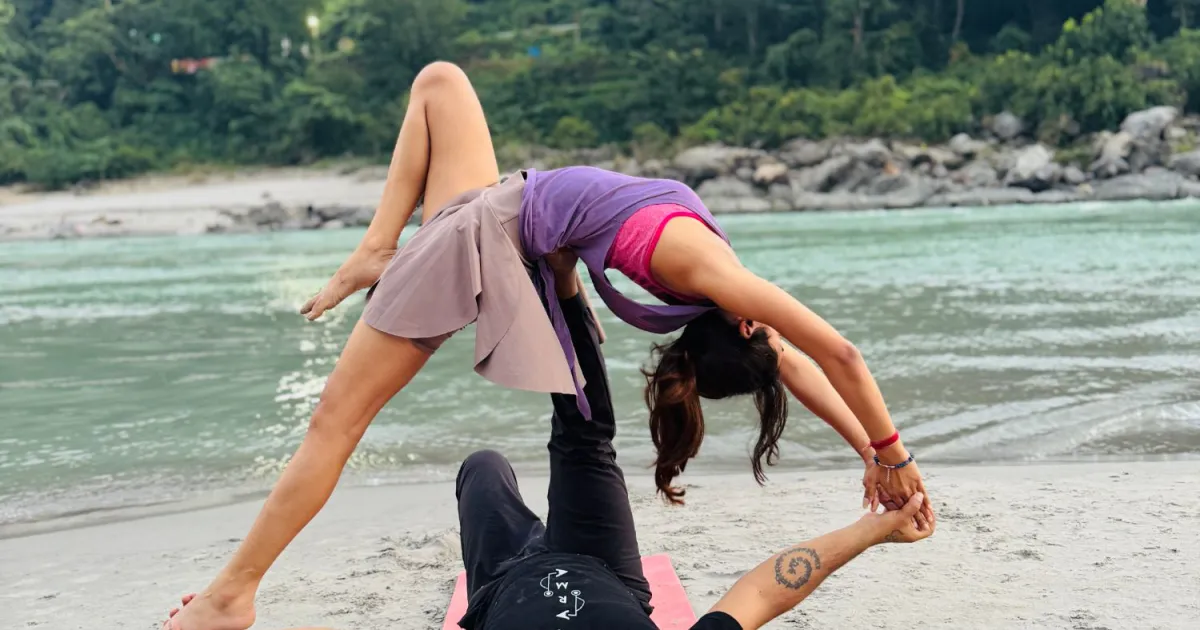
Table of Contents
Acro yoga is a partner practice that combines yoga postures with acrobatic balance: one person supports the other off the ground, usually on their feet or hands, while a third watches and keeps them safe.
Quick answer: you do not need to be strong or flexible to start. You need one partner, one person to spot, and a teacher for the first session. Most people fly in their first hour.
What acro yoga is
Strip away the photographs and acro yoga is three things happening at once: the shapes come from yoga, the mechanics come from acrobatics, and the pace comes from Thai massage — which is where its slower, therapeutic half originates.
It is almost always practised in threes, not pairs. That surprises people, and it is the single most important thing to understand before you try it.
Base, flyer, spotter
- The base lies on their back with legs in the air and carries the flyer on their feet, or stands and carries them on their hands. The job is stability, not strength — bones stacked under the load do the work, which is why bases are not always the biggest person in the room.
- The flyer is the one off the ground. Their job is to hold one shape and keep breathing. It demands far less than it looks like it does; most of the difficulty is deciding to trust the base.
- The spotter stands at the flyer's hips, hands ready, and does nothing at all unless something goes wrong. This is not the spare person. On your first day the spotter is the reason nothing bad happens, and good studios will not let you fly without one.
Most people have a preference within twenty minutes, and most teachers will make you do both anyway. You understand the practice differently from each end.
What a first session looks like
Not what the internet suggests. A good first session is roughly an hour and goes like this.
- Ten minutes of warm-up — wrists, shoulders, hamstrings, core. Dull and necessary.
- Learning to spot first. Before anyone flies, you practise catching. It reorders the fear: you find out the catch is easy, so being caught stops being frightening.
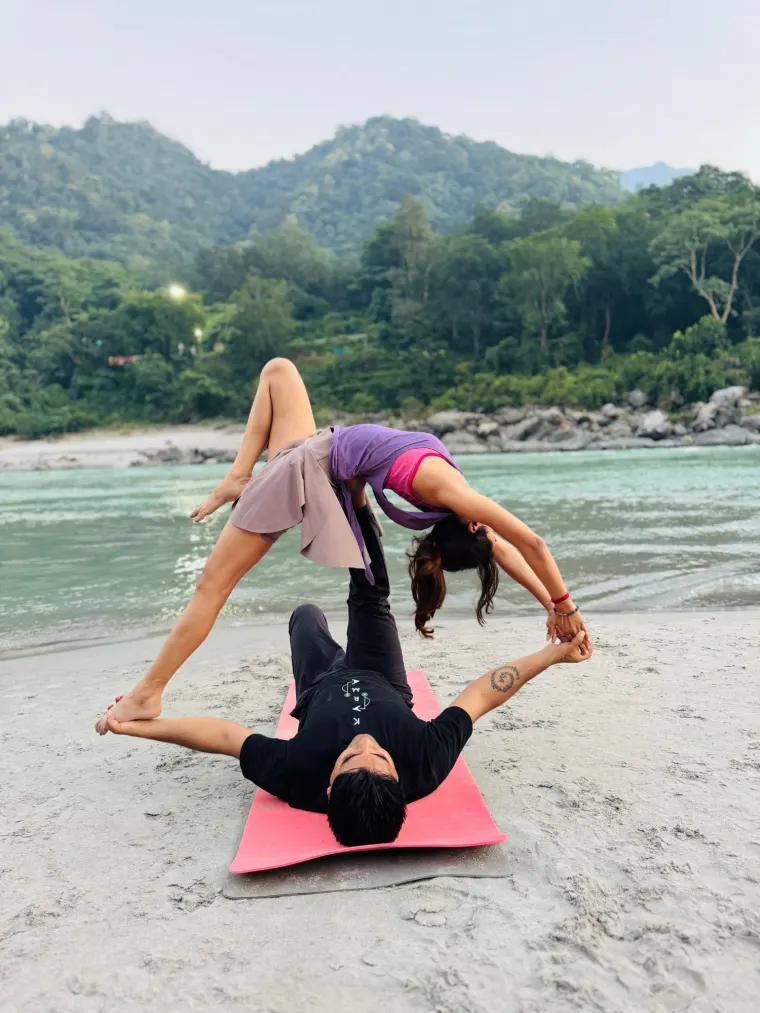
- Folded leaf. The flyer is draped face-down over the base's feet, completely passive. It is the gateway shape and it feels wonderful, like someone has hung your spine up to dry.
- Front bird or throne. The first real balance, where the flyer is open-chested and holding a shape.
- Therapeutic flying to finish — the flyer hangs upside down over the base's feet while the base gently decompresses their spine. Half the people in the room decide this was the point of the whole session.
Is it really yoga?
A fair question, and the honest answer is that it depends what you mean.
If yoga means the eight-limbed path of Patanjali, then no — acro has no scriptural lineage and nobody serious claims otherwise. If yoga means practices that use the body to work on attention, breath and the mind's relationship with fear, then acro qualifies more than most things in a modern studio.
What it genuinely does is expose your relationship with control. Flying requires you to stop managing and let someone else hold you. Basing requires you to be reliable while someone is frightened. Both are difficult in ways that have nothing to do with fitness, which is why we run it as a session on our teacher trainings rather than as a fitness class.
Safety, honestly
Acro yoga is safe when it is taught and unsafe when it is copied from a screen. The injuries are almost entirely in that second category.
- Always use a spotter for anything off the ground, for as long as either of you is new to the shape.
- Learn on a mat on grass or sand, not on tile, and not near furniture.
- The flyer calls the exit. "Down" means down immediately, with no discussion.
- The base keeps bones stacked. If you are straining, the alignment is wrong — come down rather than push through.
- Skip it if you are pregnant, or have a wrist, shoulder, neck or disc injury. Ask a doctor rather than a partner.
- Trim your nails and take off rings, which sounds trivial until somebody scratches somebody.
How to start
You do not need a strong practice, a flexible back or a partner of a particular size. You need a class with a teacher in the room for the first session, because the thing you cannot learn from a video is how to fall out of a shape safely.
If you are already practising yoga, acro will be easier than you expect — you have the body awareness, and the rest is trust. If you are completely new, do a few weeks of ordinary practice first so that "engage your core" means something to you.
Bottom line
Acro yoga is a three-person practice — base, flyer and spotter — mixing yoga shapes with acrobatic balance and Thai massage. It needs trust and communication far more than strength or flexibility, and almost everyone flies in their first session when a teacher is there to guide it.
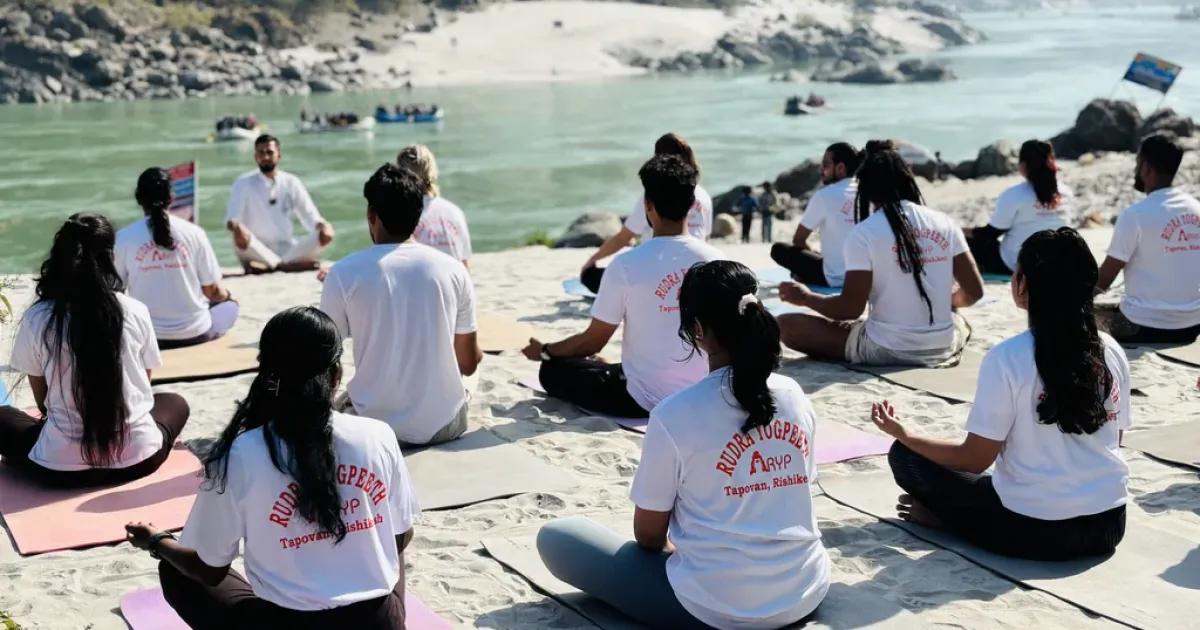
We run acro as a complimentary partner-practice session on every teacher training here, on the sand by the Ganga at Tapovan. It is included in the 200 Hour Yoga Teacher Training in Rishikesh — 24 days from ₹18,999, all-inclusive. Write to us for the next dates.
Frequently Asked Questions
What is acro yoga?
Acro yoga is a partner practice that combines yoga postures with acrobatic balance and elements of Thai massage. One person supports the other off the ground, usually on their feet or hands, while a third person spots. It is almost always practised in threes rather than pairs.
What are the three roles in acro yoga?
The base supports the flyer, usually lying on their back with legs in the air. The flyer is the person off the ground, holding one shape and breathing. The spotter stands at the flyer's hips doing nothing unless something goes wrong, and is the reason a first session is safe.
Do you need to be strong or flexible to do acro yoga?
Neither, to start. Basing works by stacking bones under the load rather than by muscling it, and flying asks far less physically than it looks. The genuinely hard part is trusting someone else to hold you.
Is acro yoga dangerous?
It is safe when taught and unsafe when copied from a screen, which is where almost all injuries come from. Use a spotter for anything off the ground, practise on a mat on grass or sand, and let the flyer call the exit at any moment.
Is acro yoga actually yoga?
It has no scriptural lineage, so by the strict definition of the eight-limbed path it is not. By the broader definition — a physical practice that works on attention, breath and your relationship with fear — it qualifies more than most things taught in a modern studio.