






Home › Blog › Rishikesh & Yoga Tourism
Rishikesh in 2026: What the Brochures Don't Show You
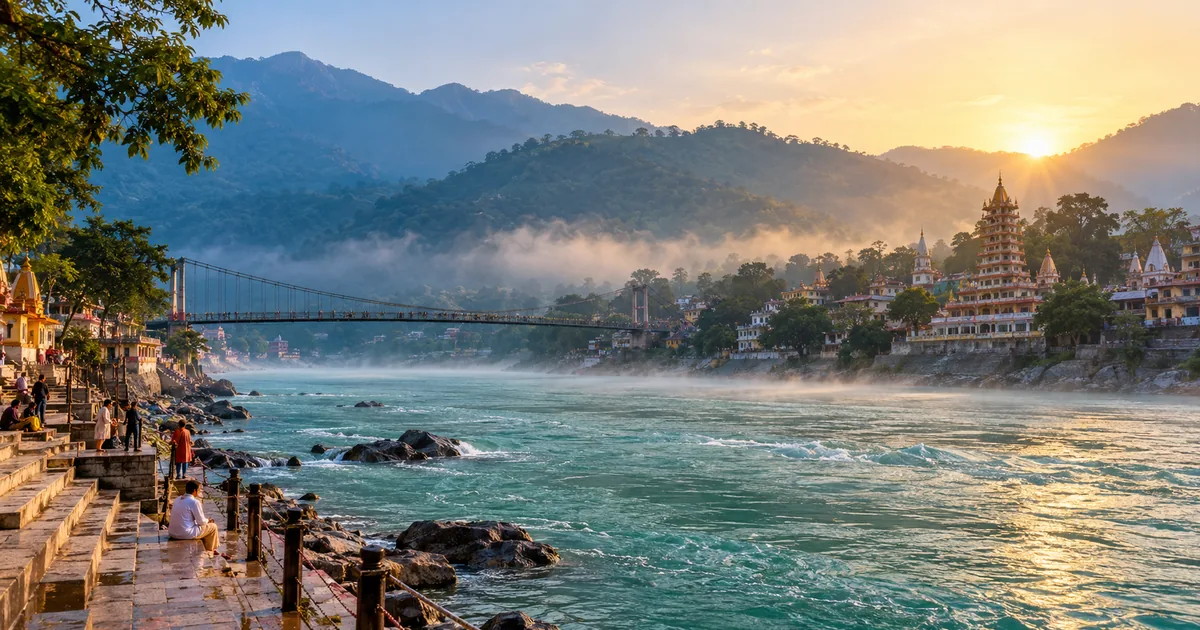
Table of Contents
Rishikesh has called itself the yoga capital of the world for about sixty years. Every school here repeats the phrase, ours included. So it is worth asking honestly, from the inside: is it still true in 2026, or is it a slogan that outlived the thing it described?
We teach here. We are not neutral. But we would rather you arrived with accurate expectations than with the brochure version.
What has genuinely changed
Rishikesh is busier and more commercial than it was a decade ago. There are far more schools than there were, and the quality range between them is wide. Laxman Jhula and Tapovan have more cafes, more shops and more traffic. If you are picturing an empty riverbank and a handful of ashrams, that picture is out of date.
Prices have risen, though they remain low by European or American standards. And the number of schools means marketing has got louder — which is precisely why choosing well has become harder than it used to be.
What has not changed at all
Three things, and they are the three that matter.
The density of teachers. Nowhere else on earth has this many experienced yoga teachers living within a few square kilometres. That is not marketing — it is the practical reason a yoga teacher training in Rishikesh can staff a specialist for each subject at a price that would be impossible in Berlin or Los Angeles.
The living tradition. Philosophy here is not a module somebody researched. It is taught by people who were taught it, in an unbroken line. You can disagree with parts of it — many students do — but you are arguing with the real thing.
The geography. The Ganga comes out of the Himalayas here. Mornings are cold and clear, the river is loud, and the town sits at the point where the mountains begin. It does something to a month of practice that an urban studio cannot replicate.
The honest downsides
If someone tells you Rishikesh has no drawbacks, stop listening to them.
- Quality varies enormously. Registration and good reviews do not separate schools, because nearly everyone has both.
- It is a dry, vegetarian town. No alcohol, no meat. Some people find this a relief and some find it a month of withdrawal.
- Monsoon is real. July and August are wet in a way that changes the whole experience.
- The noise. Temple bells, traffic, the river, dogs at night. It is not a silent retreat.
- Some schools oversell. Claims about lineage and certification that do not survive a direct question.
How it compares to the alternatives
Bali is more comfortable, more expensive, and more oriented to the experience than the study. Goa is warmer and more relaxed, with a shorter season. Kerala leans Ayurvedic and is excellent for it. A European or American course keeps you near home and costs several times more for the same hours.
What Rishikesh still wins on is depth per rupee — the number of hours with genuinely experienced teachers you can buy for what you spend. If your priority is comfort, choose elsewhere. If it is the training itself, this is still the place.
Practical things worth knowing before you come
A few details that change the experience more than people expect.
- Season matters more than the school. February to April and September to November are the comfortable months. June–August is monsoon; December–January is genuinely cold in unheated rooms.
- Getting here: fly to Delhi, then a short domestic hop to Dehradun or the overnight train to Haridwar. Road transfer from Dehradun is about an hour.
- Cash still matters. Cards work in bigger places; the small shops and auto drivers want cash.
- Dress modestly off the mat. It is a pilgrimage town as much as a yoga town, and the two sit side by side.
- The river is fast. The Ganga here is mountain water moving quickly. Swim only where locals swim.
So — still the capital?
Yes, with a condition attached. Rishikesh is still where the deepest concentration of yoga teaching in the world lives. It is also where the widest range of quality lives. The town has not declined; the noise around it has grown.
Which means the title is no longer a reason to come. It is a reason to choose carefully once you have.
If you want the questions that actually separate one school from another, we set them out in why most yoga instructor training in India disappoints.